
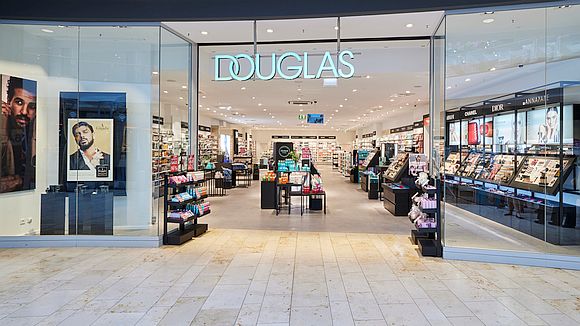
DOUGLAS Group adjusts retail strategy as digital beauty shopping gains momentum. The DOUGLAS Group reported third-quarter sales of €987.8 million for April to June 2026, a year-on-year decline of 2.0%. Weak market conditions in Germany, France and the Netherlands, combined with continued price competition, affected profitability, while e-commerce and cross-channel services continued to gain relevance. The company confirmed its full-year guidance and plans to provide an update on its “Let it Bloom” strategy in the fourth quarter of 2026.
Third-quarter performance reflects market pressure
The DOUGLAS Group’s third quarter of financial year 2025/2026 was shaped by cautious consumer demand and a competitive European premium beauty market. Sales declined by 2.0% year on year to €987.8 million between April and June 2026. Adjusted EBITDA fell by 19.4% to €127.5 million. The adjusted EBITDA margin stood at 12.9%, compared with the previous year’s level. The results were in line with the company’s expectations. For the first nine months of the financial year, sales increased slightly by 0.5% to €3.61 billion. This development was supported by e-commerce, which grew by 2.3% during the period. Adjusted EBITDA declined by 9.0% to €577.3 million, resulting in a margin of 16.0%. The group’s net leverage was 3.1 times as of 30 June 2026, or 2.2 times before leases. Cash generation remained relatively stable, although free cash flow decreased from €412.8 million in the previous financial year to €399.2 million. The conversion of adjusted EBITDA into free cash flow improved to approximately 70%.
Germany, France and the Netherlands weigh on growth
The performance of the three largest markets presented a challenge during the quarter. Germany, France and the Netherlands together account for around 60% of the DOUGLAS Group’s overall business.Consumer demand for premium beauty products was lower than in the previous year in Germany and the Netherlands. France recorded flat demand. As a result, sales in the DACHNL segment declined by 2.8%, while France reported a decrease of 2.1%. The market environment in Germany was affected by intense competition, including more aggressive pricing. The online retailer Parfumdreams also experienced temporary operational constraints affecting its shop operations. This contributed to a 10.4% decline in the Parfumdreams/Niche Beauty segment. By contrast, Central Eastern Europe continued to develop positively. Sales in the region increased by 4.4% during the third quarter. Poland, Spain and Italy were identified as more dynamic markets compared with the group’s larger Western European markets.
DOUGLAS Group adjusts retail strategy – E-commerce changes the channel mix
The shift from physical shops to digital purchasing continued during the quarter. E-commerce sales across the group decreased slightly by 1.0%, mainly due to the development of Parfumdreams/Niche Beauty. Excluding this segment, e-commerce sales increased by 0.6%. The channel performed particularly well in Central Eastern Europe, Southern Europe and France, where online sales account for up to one quarter of total sales in the respective markets. E-commerce achieved double-digit growth in these regions. In DACHNL, where e-commerce represents around 40% of total sales, the channel declined by 4.9%. The segment faced higher levels of price-led competition and more pressure on consumers’ discretionary spending.For employees in perfumery retail and cosmetics manufacturing, this development highlights the importance of managing both digital and physical customer journeys. Product visibility, pricing, availability and customer service must increasingly work across channels rather than being planned separately for shops and online platforms.
Cross-channel services support customer retention
While the balance between stores and e-commerce continues to change, cross-channel services remain an important part of the retail model. Click & Collect Express sales increased by 18.2% during the third quarter. Services that connect digital ordering with local shops can provide customers with greater convenience while maintaining a role for physical locations. They may also support stock utilisation and create additional opportunities for customer interaction in-store. Exclusive brands also contributed to differentiation. Brands including about-face, Lolavie, Morphe and Balmain Paris recorded double-digit sales growth in the quarter. The group’s Retail Media business increased sales by 24%, reflecting the growing importance of digital advertising and brand visibility within retail platforms.For cosmetics manufacturers, exclusive and corporate brands can provide a way to reduce direct comparability with competing products. For retailers, they may support assortment differentiation and create additional commercial opportunities.
Stores face closer profitability reviews
The DOUGLAS Group has begun a structural assessment of its store network. Locations are being reviewed with regard to profitability and customer footfall. The group intends to continue opening selected new locations, particularly in Eastern Europe, while modernising stores in Western Europe. In major Western European markets, however, the company expects to adjust the balance between physical and digital operations in line with changing customer behaviour. This does not indicate a complete withdrawal from bricks-and-mortar retail. Instead, the approach places greater emphasis on the role and commercial performance of each location. Stores may increasingly be expected to support services such as click and collect, product advice, brand experiences and fulfilment, in addition to traditional sales.
“Let it Bloom” strategy to be updated
The company plans to present further details of its evolving “Let it Bloom” strategy in the fourth quarter of calendar year 2026. The updated strategy is expected to focus on technology, digital user experience and cross-channel services. Other priorities include a profitable and resilient store network, greater use of exclusive and corporate brands, a sustainable pricing strategy, and further standardisation and simplification of organisational processes. The company has confirmed its full-year guidance for financial year 2025/2026. It expects net sales growth of 0–1%, corresponding to sales of between €4.58 billion and €4.63 billion. The adjusted EBITDA margin is expected to be approximately 15%, while net leverage is forecast to be between 3.0 and 3.5 times as of 30 September 2026.
Implications for the beauty retail sector
The results underline several developments relevant to the wider beauty industry: price sensitivity remains high, e-commerce continues to influence the channel mix, and physical shops are being assessed according to their individual contribution to the wider customer journey. Retailers and manufacturers may therefore need to place greater emphasis on consistent product information, flexible fulfilment, exclusive ranges and pricing that remains competitive without weakening brand positioning. The next strategy update from the DOUGLAS Group is expected to provide further detail on how these priorities will be implemented across its 22 omnichannel countries.
[Text: epcnews/Photo: Douglas]
